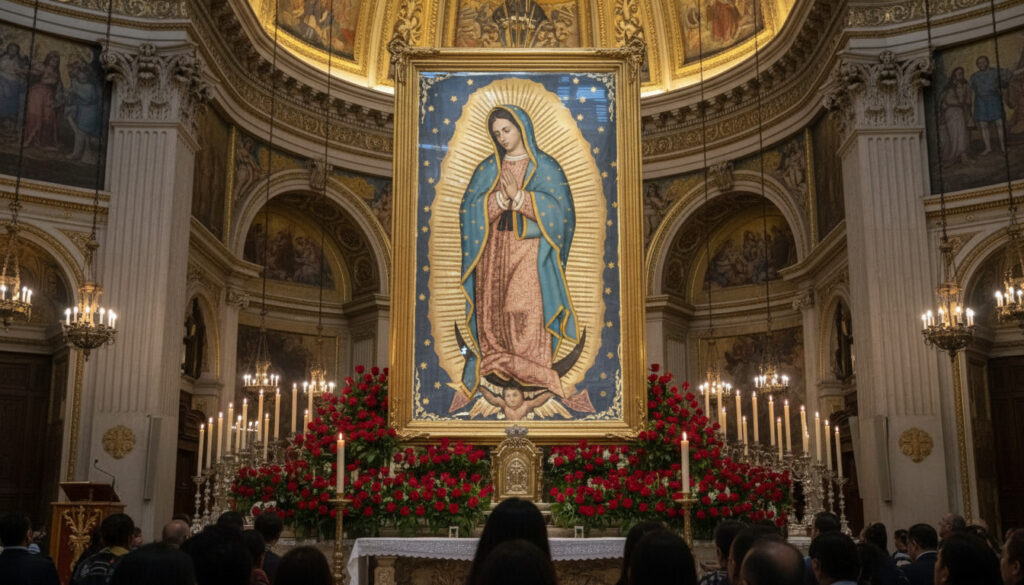
Our Lady of Guadalupe – History, Tilma Miracle and Significance
Our Lady of Guadalupe represents a series of Marian apparitions that occurred in December 1531 on Tepeyac Hill near Mexico City, involving an indigenous peasant named Juan Diego and a miraculous image imprinted on his cactus-fiber cloak. These events, recognized by the Catholic Church as an approved apparition, have generated more than 20 million annual pilgrims to the Basilica of Our Lady of Guadalupe, making it one of the world’s most visited Catholic shrines.
The visions emerged during a critical period of cultural transition following the Spanish conquest of the Aztec Empire, establishing what historians and theologians describe as a synthesis of Christian and indigenous Mexican spirituality. The Virgin Mary reportedly spoke Nahuatl, the Aztec language, and appeared with physical features resonating with the indigenous population.
This examination traces the historical timeline, scientific investigations into the tilma, and the cultural significance that elevated these apparitions to global religious prominence.
What is the story of Our Lady of Guadalupe?
The narrative centers on five separate visions occurring between December 9 and December 12, 1531, documented primarily in the Nahuatl text Nican Mopohua. Juan Diego Cuauhtlatoatzin, a Chichimec peasant born circa 1474, was traveling to Mass when he first observed a luminous young woman amid celestial sounds on Tepeyac Hill. Speaking Nahuatl, she identified herself as the “mother of the very true deity” and requested that Bishop Juan de Zumárraga construct a church at that location. Historical records indicate the bishop initially dismissed the request, prompting a second encounter where the Virgin urged persistence.
When the bishop requested a miraculous sign, the Virgin promised one for the following day. Juan Diego missed this appointment because his uncle, Juan Bernardino, lay gravely ill. During a fourth apparition on December 12, she directed him to gather roses from the hilltop despite the winter season. When he presented these flowers to the bishop, they fell from his tilma, revealing her exquisitely colored image imprinted on the coarse cactus fiber. A fifth apparition that same day cured Juan Bernardino and established the title “Guadalupe.”
- The apparitions precipitated an estimated 8 million indigenous conversions to Catholicism within a single decade.
- The primary historical account, known as the Nican Mopohua, was composed in Nahuatl and first published in 1649.
- Juan Diego Cuauhtlatoatzin, the witness, was a Chichimec Aztec convert born circa 1474.
- The Virgin identified herself as the “mother of the very true deity” during the visions.
- Five distinct apparitions occurred between December 9 and December 12, 1531.
- The events occurred just ten years after the fall of the Aztec capital of Tenochtitlan in 1521.
- Pope Pius XII designated her Patroness of the Americas in 1945.
| Fact | Details |
|---|---|
| Feast Day | December 12 |
| Canonized Witness | St. Juan Diego (2002) |
| Image Material | Cactus fiber tilma (ayate) |
| Annual Visitors | 20+ million |
| Church Status | Approved apparition |
| Primary Language | Nahuatl |
| Historical Text | Nican Mopohua (1649) |
| Patroness Declaration | 1945 (Pius XII) |
What is the miracle of the tilma?
The central miracle involves the image’s appearance on Juan Diego’s tilma, a garment woven from ayate, a coarse cactus fiber that typically deteriorates within 20 years under normal conservation conditions. When the roses fell from the cloak on December 12, 1531, the bishop and witnesses observed an image of the Virgin Mary exactly matching Juan Diego’s descriptions, with no visible means of application.
Physical Anomalies
Scientific examinations conducted since the 1970s, including infrared reflectography and digital photography, have failed to detect brushstrokes, underdrawing, or size application on the fabric. The image shows no cracking or fading after nearly five centuries of exposure. Studies by researchers including those from NASA in the late 20th century confirmed the image lacks pigments consistent with known artistic techniques from the period.
The tilma consists of ayate, a coarse cactus fiber that typically deteriorates within 20 years under normal conservation conditions. The fabric has remained intact for nearly five centuries without displaying the decay patterns associated with organic vegetable fibers of this type.
Optical Observations
Ophthalmological studies of the image’s eyes suggest they contain reflected figures resembling human witnesses, interpreted by some researchers as representing the individuals present during the unveiling to Bishop Zumárraga. The stars on the Virgin’s mantle correspond to constellation positions visible during the winter solstice of 1531, matching astronomical records for the Mesoamerican sky in December of that year. Detailed material analysis continues to investigate these unexplained properties.
Why is Our Lady of Guadalupe important?
The apparitions established a cultural bridge between the conquering Spanish and indigenous populations, facilitating mass conversion while preserving distinct Mexican identity. Unlike European Marian apparitions, the Virgin of Guadalupe appeared with darkened skin, speaking the local language, and utilizing iconography comprehensible to the Nahua population.
Symbolic Interpretations
The image synthesizes Catholic and Aztec religious symbols. The mantle stars align with the 1531 winter solstice sky, while the maternity sash and black ribbon follow indigenous conventions signifying pregnancy. The sun rays and moon imagery reference the conquest of Aztec solar and lunar deities, creating a visual theology accessible to converts.
Research indicates the stars on the Virgin’s mantle correspond to the winter solstice sky of 1531, specifically reflecting constellations visible in Mesoamerica during December of that year.
The maternity sash and black ribbon follow indigenous Mexican conventions signifying pregnancy, while the sun rays and moon imagery reference the conquest of Aztec solar and lunar deities, creating a sophisticated theological communication accessible to the Nahua population.
Cultural historians note that this syncretism spurred an estimated eight million conversions within a decade, creating what scholars term mestizo Christianity. The site at Tepeyac previously hosted a shrine to Tonantzin, an indigenous mother goddess, suggesting continuity of sacred geography that facilitated religious transition.
Where is the image of Our Lady of Guadalupe located?
The original tilma is housed in the Basilica of Our Lady of Guadalupe, located at coordinates 19°29′04″N 99°07′02″W in northern Mexico City. The modern Basilica, completed in 1976, replaced earlier colonial structures that had sunk due to unstable lakebed soil. Pilgrims visiting the complex can view the image from a moving walkway positioned beneath the bulletproof glass protecting the relic.
The site attracts over 20 million visitors annually, with peak attendance occurring on the December 12 feast day. The complex includes the old Basilica, constructed between 1695 and 1709, along with chapels, gardens, and the 189 cm in Feet Conversion Guide might seem unrelated, but measurements of the tilma itself—approximately 172 cm by 109 cm—have been precisely documented by conservationists studying its preservation.
When did the apparitions occur to Juan Diego?
- : Juan Diego encounters a luminous young woman with darkened skin on Tepeyac Hill amid celestial music. She requests that Bishop Juan de Zumárraga build a church at the site. Queen of the Americas Guild
- : Following the bishop’s request for a sign, the Virgin promises a miraculous confirmation, though Juan Diego cannot attend due to his uncle’s grave illness.
- : The Virgin directs Juan Diego to gather out-of-season roses from the hilltop. When he presents these to the bishop, they fall from his tilma, revealing her imprinted image. National Shrine
- : A fifth apparition occurs to Juan Bernardino, Juan Diego’s uncle, curing his illness and establishing the title “Guadalupe.”
- : Bishop Zumárraga approves the construction of a chapel at Tepeyac, marking official ecclesiastical recognition of the events.
- : The Nahuatl account Nican Mopohua is published in Huei tlamahuiçoltica, providing the primary historical documentation.
- : Pope John Paul II canonizes Juan Diego, affirming the historical validity of the apparitions. Vatican News Service
What facts are established versus disputed?
| Established Information | Information Requiring Further Clarification |
|---|---|
| The Catholic Church officially approved the apparitions in 1531 and canonized Juan Diego in 2002. | The precise astronomical significance of the stars on the mantle remains subject to ongoing scholarly interpretation. |
| The tilma has been preserved at the Basilica since the 16th century and displays no brushstrokes or underdrawing. | The exact nature of the image formation process has not been definitively explained by scientific analysis. |
| Juan Diego was an indigenous Chichimec peasant baptized around 1524. | The extent of continuity between the Tepeyac site and pre-Hispanic Tonantzin worship requires additional archaeological evidence. |
| Over 20 million pilgrims visit the shrine annually. | Specific details of Juan Diego’s early life and family lineage remain historically obscure. |
How did the apparitions influence Mexican society?
The visions occurred during the demographic catastrophe following the Spanish conquest, when indigenous populations faced collapse from introduced diseases and social dislocation. Historical analysis suggests the apparitions facilitated an unprecedented spiritual integration, with an estimated eight million indigenous Mexicans converting to Catholicism within a decade of the events.
This rapid conversion established what scholars term mestizo Christianity, blending European Catholic devotion with indigenous Mexican cultural expressions. The Virgin’s darkened skin and Nahuatl speech created an immediate cultural connection that distinguished these apparitions from earlier European Marian traditions.
The symbolism embedded in the image demonstrated sophisticated theological communication accessible to the Nahua population while maintaining orthodox Catholic Mariology. Vatican documentation affirms her role as Patroness of the Americas, extending her significance beyond Mexico to encompass Canada, the United States, and South America.
What do primary sources record?
The Nican Mopohua, composed in Classical Nahuatl by the scholar Antonio Valeriano, provides the earliest detailed narrative of the apparitions. This text, published in 1649 as part of Huei tlamahuiçoltica, remains the foundational historical document.
Hear me, my youngest son, and understand that I am the ever-virgin Mary, Mother of the True God, through whom everything lives…
— Nican Mopohua (excerpt)
The account details the interactions between Juan Diego and the Virgin, including her specific requests and the miraculous provision of roses. Vatican archives contain the canonical documentation supporting Juan Diego’s 2002 canonization, including investigations into the historical certainty of the events.
Why does Our Lady of Guadalupe remain significant today?
Our Lady of Guadalupe persists as a unifying figure across the Americas, representing both religious devotion and cultural identity for millions. The Dental Braces vs Invisalign Comparison illustrates modern precision in orthodontic assessment, paralleling the meticulous scientific scrutiny applied to the tilma’s preservation. The shrine at Tepeyac continues to draw multitudes seeking connection with this 16th-century intersection of indigenous and Catholic traditions, while her image appears in religious ceremonies, social movements, and cultural expressions throughout the hemisphere.
Frequently Asked Questions
Is Our Lady of Guadalupe approved by the Catholic Church?
Yes. The Catholic Church officially approved the apparitions in 1531 when Bishop Juan de Zumárraga authorized the construction of a chapel at Tepeyac. Pope John Paul II canonized Juan Diego in 2002, confirming the historical validity of the events.
What is the feast day of Our Lady of Guadalupe?
The feast day is celebrated annually on December 12, commemorating the final apparition and the miracle of the tilma in 1531. This date marks the appearance of the image on Juan Diego’s cloak and the Virgin’s instruction to adopt the title “Guadalupe.”
What traditions mark the December 12 celebration?
Millions of pilgrims travel to the Basilica in Mexico City, many crawling on their knees for the final meters. Celebrations include midnight Masses, processions with floral offerings, and the singing of “Las Mañanitas.” Communities across the Americas hold special services and cultural festivals.
How can visitors access the Basilica of Our Lady of Guadalupe?
The Basilica is located at coordinates 19°29′04″N 99°07′02″W in northern Mexico City. Visitors can reach the site via the Mexico City Metro (La Villa-Basílica station) or bus services. The complex includes the modern Basilica, historical chapels, and gardens open to pilgrims year-round.
Who was Juan Diego before the apparitions?
Juan Diego Cuauhtlatoatzin was a Chichimec peasant born circa 1474 who was baptized around 1524, likely by Franciscan missionaries. He lived a humble life as a widower and convert to Catholicism, working as a farmer and mat weaver before the December 1531 visions.
What makes the tilma’s preservation scientifically unusual?
The ayate cactus fiber should have deteriorated within 20 years, yet the tilma remains intact after nearly 500 years. Infrared analysis reveals no underdrawing or brushstrokes, and the image shows no cracking or fading despite centuries of exposure.
More related posts
 NL Health Services Careers: Portal Access and Application Guide
 Inter Milan vs Bayern Munich Lineups – Predicted XIs and Team News
 Hell’s Paradise Season 2 – Release Date, Trailer and Streaming Guide
 61 USD to CAD – 84.86 CAD Rate April 1, 2026
 Eva Longoria Movies and TV Shows – Complete Filmography and Best Roles
 You’re Welcome in French – Casual and Formal Responses Guide
 Premier Ministre du Québec: Christine Fréchette Current Premier
 When the Phone Rings: K-Drama Plot, Ending Explained