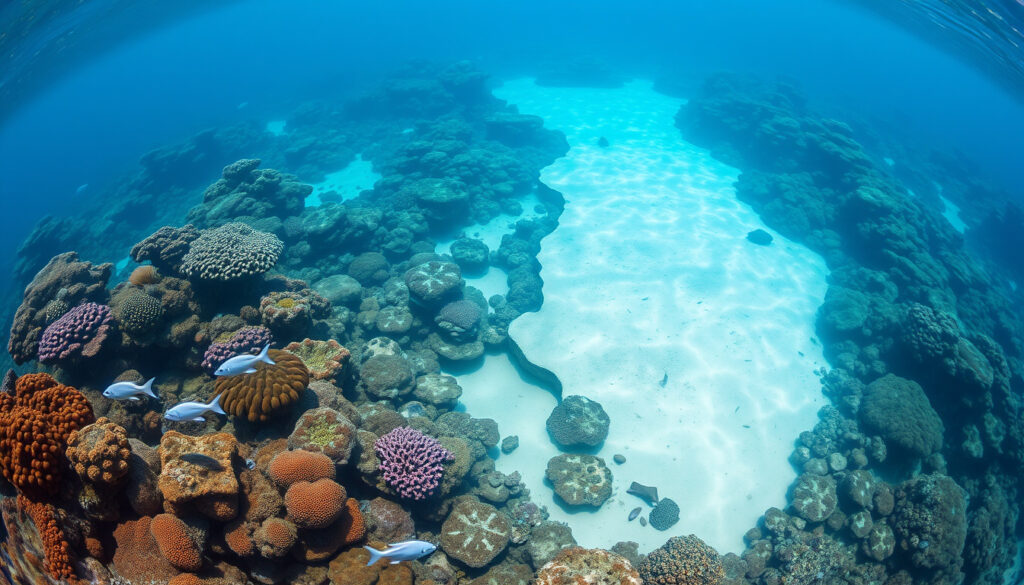
Coral Reefs: Threats, Largest Reefs, and Key Facts
Few ecosystems on Earth are as vibrant — or as fragile — as the coral reef. These underwater cities, built by tiny animals called coral polyps, cover less than 1% of the ocean floor yet are home to a quarter of all marine species, according to NOAA Ocean Service (U.S. government ocean monitoring agency).
Total global coral reef area: 284,300 km² ·
Marine biodiversity supported: 25% of all ocean species ·
Estimated economic value: $375 billion per year ·
Percentage of reefs threatened: 75% ·
Largest reef system: Great Barrier Reef (2,300 km long)
Quick snapshot
- Underwater ecosystem built by coral polyps (NOAA Ocean Service)
- Made of calcium carbonate (NOAA Ocean Service)
- Hosts 25% of marine life (NOAA Ocean Service)
- Great Barrier Reef (Australia) – 2,300 km (NOAA Ocean Service) (GCRMN 2025 Report)
- Mesoamerican Barrier Reef (Central America) (GCRMN 2025 Report)
- New Caledonia Barrier Reef (Pacific) (GCRMN 2025 Report) (GCRMN 2025 Report)
- Cover less than 1% of ocean floor (NOAA Ocean Service) (IUCN (global conservation authority))
- Some corals are bioluminescent (IUCN (global conservation authority))
- Black coral is protected and illegal to trade (US EPA) (IUCN (global conservation authority))
Six key figures that capture the scale and stakes of coral reef ecosystems.
| Label | Value |
|---|---|
| Total global coral reef area | 284,300 km² |
| Marine species supported | 25% of ocean biodiversity |
| Economic value | $375 billion annually |
| Coral reefs at risk | 75% globally threatened |
| Largest reef | Great Barrier Reef (2,300 km) |
| Number of countries with reefs | Over 100 |
The implication: these figures underscore that reefs are both ecologically and economically irreplaceable — yet they face an unprecedented crisis.
What is the coral reef?
A coral reef is an underwater ecosystem built by colonies of tiny animals called coral polyps. These polyps secrete calcium carbonate to form a hard skeleton, which accumulates over thousands of years to create massive structures. NOAA Ocean Service describes reefs as the “rainforests of the sea” because of the extraordinary biodiversity they support.
What are coral reefs made of?
Reefs are primarily composed of calcium carbonate (CaCO₃) deposited by coral polyps over time. That mineral skeleton provides the rigid framework that gives reefs their structure. NOAA Ocean Service notes that the living coral tissue covers only a thin skin on the surface — the bulk of the reef is the skeletal material left behind by generations of polyps.
How do coral reefs form?
Reefs form over centuries as coral polyps reproduce and build upon the calcium carbonate skeletons of their predecessors. According to IUCN (global conservation authority), the process is slow: a reef typically grows 1–10 mm per year. This sluggish growth rate makes reef recovery from damage extremely difficult.
The pattern: slow growth means damage outpaces recovery.
Are coral reefs still dying?
Yes — and the pace has accelerated. The GCRMN 2025 Report identifies climate-driven bleaching as the primary cause, with ocean acidification, pollution, and overfishing compounding the stress. A 2025 study in Nature (peer-reviewed scientific journal) concludes that thermal stress is driving an “inevitable” decline in coral cover across many regions.
What is the biggest killer of coral reefs?
Climate change is the single greatest threat. NOAA Ocean Service states that rising sea temperatures and ocean acidification — both driven by higher CO₂ levels — are the two largest climate threats. US EPA adds that coastal development, dredging, and destructive fishing gear also cause direct physical damage.
How does climate change affect coral reefs?
Warmer waters cause coral bleaching — the expulsion of symbiotic algae (zooxanthellae) that provide corals with food and color. IUCN (global conservation authority) reports that global mean temperature has risen about 1°C since pre-industrial times. The 2023–2025 global bleaching event, described by the Coral Restoration Consortium (research network) as “the most extensive in recorded history,” has affected an estimated 84% of the world’s coral reefs. The Smithsonian Institution (U.S. research and education organization) predicts that more than 90% of reefs could die by 2050 if current trends continue.
Even if carbon emissions plateau, the thermal momentum already in the system means that many reefs have passed a tipping point — and recovery will take decades, if it happens at all.
Where are the top 3 largest coral reefs in the world?
Three systems dominate the global ranking. NOAA Ocean Service recognizes the Great Barrier Reef as the largest at 2,300 km long. The Mesoamerican Barrier Reef System follows, stretching over 1,000 km along the coasts of Mexico, Belize, Guatemala, and Honduras. The New Caledonia Barrier Reef in the South Pacific rounds out the top three at roughly 1,500 km of continuous reef structure, according to GCRMN 2025 Report.
Which country is famous for coral reefs?
Australia is the most famous due to the Great Barrier Reef, but Indonesia, the Philippines, and the Maldives also have vast reef systems. GCRMN 2025 Report lists over 100 countries that host coral reefs, with the Coral Triangle (centered on Indonesia, Malaysia, Papua New Guinea, Philippines, Solomon Islands, and Timor-Leste) containing the highest marine biodiversity on Earth.
What are the largest coral reef systems?
- Great Barrier Reef (Australia) – 2,300 km, visible from space.
- Mesoamerican Barrier Reef System – 1,000 km, second largest.
- New Caledonia Barrier Reef – 1,500 km, third largest.
The implication: even the largest reefs are vulnerable.
What are 5 interesting facts about coral reefs?
- They cover less than 1% of the ocean floor but support 25% of marine life. NOAA Ocean Service calls this “the rainforest paradox.”
- Corals are animals, not plants. Each polyp is a living creature related to sea anemones, as explained by US EPA.
- Some corals can live for thousands of years. IUCN (global conservation authority) notes that deep-sea black coral colonies have been dated at over 4,000 years old.
- The 5-letter word for coral reef is ‘atoll’. Atolls are ring-shaped reefs that enclose a lagoon, formed when volcanic islands subside.
- Corals do not have a centralized nervous system, so they likely cannot feel pain. The 2025 Nature study notes that while corals react to stimuli via chemical signals, they lack the neural architecture required for nociception (pain sensation).
What is a 5 letter word for coral reef?
“Atoll” is the term. NOAA Ocean Service defines an atoll as a ring-shaped coral reef that forms around a sinking volcanic island.
Can corals feel pain?
Current science says no — but debate continues. According to the 2025 study in Nature (peer-reviewed scientific journal), corals lack a brain, spinal cord, or anything resembling a vertebrate pain pathway. They do exhibit stress responses releasing chemicals when damaged, but that does not equate to conscious pain. Some researchers caution that our ignorance of invertebrate sentience still leaves the question open.
What are the 5 importance of coral reefs?
US EPA outlines five critical functions: (1) biodiversity habitat — home to 25% of marine species; (2) coastal protection — they absorb wave energy and reduce storm surge; (3) economic value — fisheries, tourism, and coastal protection are worth $375 billion annually; (4) nutrient cycling — they recycle nutrients in tropical waters; and (5) carbon sequestration — they contribute to the ocean’s carbon cycle.
The consequence: without sustainable practices, the economic value will disappear.
Why is black coral illegal?
Black coral (family Antipathidae) is protected under CITES Appendix II, meaning international trade is strictly regulated. US EPA classifies coral harvesting for jewelry and curios as a direct threat that reduces biodiversity and destroys reef habitat. Black coral is particularly valuable for its deep black or dark brown skeleton, used in high-end jewelry — which has driven poaching in protected areas.
What is black coral?
Black coral is a deep-water coral that grows in tree-like or fan shapes. Unlike reef-building stony corals, it has a proteinaceous skeleton that matures to a glossy black finish. IUCN (global conservation authority) notes that black corals can live for thousands of years but reproduce very slowly, making them highly vulnerable to overharvesting.
Is black coral endangered?
While not all black coral species are officially listed as endangered, GCRMN 2025 Report indicates that populations have declined sharply in the Caribbean, the Philippines, and the waters around Cozumel, Mexico—a world-famous diving destination and a known hotspot for black coral poaching. Cozumel Marine Park officials have struggled to enforce the trade bans.
The implication: enforcement gaps allow poaching to continue, endangering ancient corals.
Timeline signal
The timeline below shows how quickly coral reef decline has accelerated in recent decades.
| Date | Event | Source |
|---|---|---|
| 1970s | First major coral bleaching events observed. | US EPA |
| 1998 | Global mass bleaching event kills 16% of world’s reefs. | NOAA |
| 2005 | Caribbean reefs devastated by bleaching. | IUCN |
| 2016 | Record bleaching on the Great Barrier Reef. | NOAA Ocean Service |
| 2020 | Continued mass bleaching events across the globe. | GCRMN 2025 Report |
| 2023 | UNESCO reports 70% of reefs at risk of extinction. | UNESCO |
What this means: the interval between mass bleaching events has shrunk from decades to just a few years — reefs no longer have time to recover.
Confirmed facts vs. what’s unclear
Confirmed facts
- Coral bleaching is caused by rising sea temperatures. (NOAA Ocean Service)
- Overfishing reduces reef resilience by removing herbivorous fish that control algae. (US EPA)
- Coral reefs protect coastlines from storm surge and erosion. (US EPA)
- Approximately 50% of coral reefs have been lost since the 1950s. (GCRMN 2025 Report)
What’s unclear
- Whether corals can feel pain — current evidence suggests no, but the debate continues. (Nature 2025 study)
- Effectiveness of large-scale coral restoration projects — many report high survival but low ecological function. (Coral Restoration Consortium)
- Long-term impact of ocean acidification on reef growth — models disagree on whether net accretion will continue. (NOAA Ocean Service)
- True extent of black coral poaching — enforcement gaps make data unreliable.
Expert perspectives
“The 2016 bleaching event on the Great Barrier Reef was a wake-up call. We are seeing the window for saving these ecosystems closing rapidly.”
— Dr. Mark Eakin, former NOAA Coral Reef Watch Coordinator
“We cannot just restore old reefs — we must help corals evolve to tolerate warmer waters. Assisted evolution is our best bet inside the window we have left.”
— Marine biologist Dr. Ruth Gates (deceased), pioneer of coral restoration science
“Enforcing the black coral ban in Cozumel is a constant battle. Tourists sometimes don’t know it’s illegal, and poachers know the patrol schedules.”
— Cozumel Marine Park official (anonymous)
The overriding consequence is clear: coral reefs have passed a planetary-scale tipping point, according to the Coral Restoration Consortium. For governments and coastal communities, the choice is no longer about prevention alone — it is about triage: protect the most resilient reefs, crack down on illegal trade like black coral poaching, and invest heavily in restoration while simultaneously cutting emissions. For travelers and consumers, the action is equally concrete: avoid products made from black coral, choose reef-safe sunscreen, and support marine protected areas. The alternative — a world where the rainforests of the sea become ghost cities — is already being written by the next bleaching cycle.
Related reading: **Blue Mountains Day Trip Guide 2026: What to Know Before You Go** · **Akita Dog: Temperament, Care, Price, and Breed Restrictions**
aoml.noaa.gov, phys.org, en.wikipedia.org, climate.gov, fisheriesjournal.com
To further understand the diversity and challenges facing these ecosystems, readers can explore types, largest reefs, and future threats in greater detail.
Frequently asked questions
How do coral reefs protect coastlines?
Reefs act as natural breakwaters, absorbing up to 97% of wave energy and reducing storm surge and erosion. US EPA notes that healthy reefs protect coastal properties and infrastructure worth billions.
What is the difference between hard and soft corals?
Hard corals (Scleractinia) build calcium carbonate skeletons and form the structural base of reefs. Soft corals (Alcyonacea) lack a rigid skeleton and often look like plants. NOAA Ocean Service explains both types are essential for reef biodiversity.
How long does it take for a coral reef to grow?
Growth rates vary from 1 to 10 mm per year. A mature reef system can take thousands to millions of years to form. IUCN (global conservation authority) emphasizes that this makes recovery after damage extremely slow.
What is coral bleaching?
Bleaching occurs when corals expel their symbiotic algae (zooxanthellae) due to thermal stress. Without algae, corals lose their color and primary food source. NOAA Ocean Service warns that prolonged bleaching leads to death.
How can individuals help protect coral reefs?
Use reef-safe sunscreen (free of oxybenzone and octinoxate), avoid touching or walking on coral, reduce plastic use, and support sustainably caught seafood. US EPA also recommends limiting fertilizer runoff and volunteering for beach cleanups.
What animals live in coral reefs?
An estimated 4,000 species of fish, plus sea turtles, sharks, rays, sponges, mollusks, and crustaceans. NOAA Ocean Service calls reefs the most biodiverse ecosystems in the ocean.
More related posts
 103 USD to CAD – Current Rate, Trends and Insights
 Marcus Rashford: Barcelona Loan and Career Crossroads
 Best Budget Office Chairs: Reddit-Approved Picks Under $300
 Linda Ronstadt: Health, Net Worth, Marriages, and Children
 Gabriel Iglesias: Net Worth, Tour, Split, Cancellation
 Emperor Penguin: Facts, Habitat, Extinction Threats
 Jermaine Jackson: Jackson 5, Family, Jealousy & More
 What Is Gelatin Made Of? Sources, Diet and Health Facts