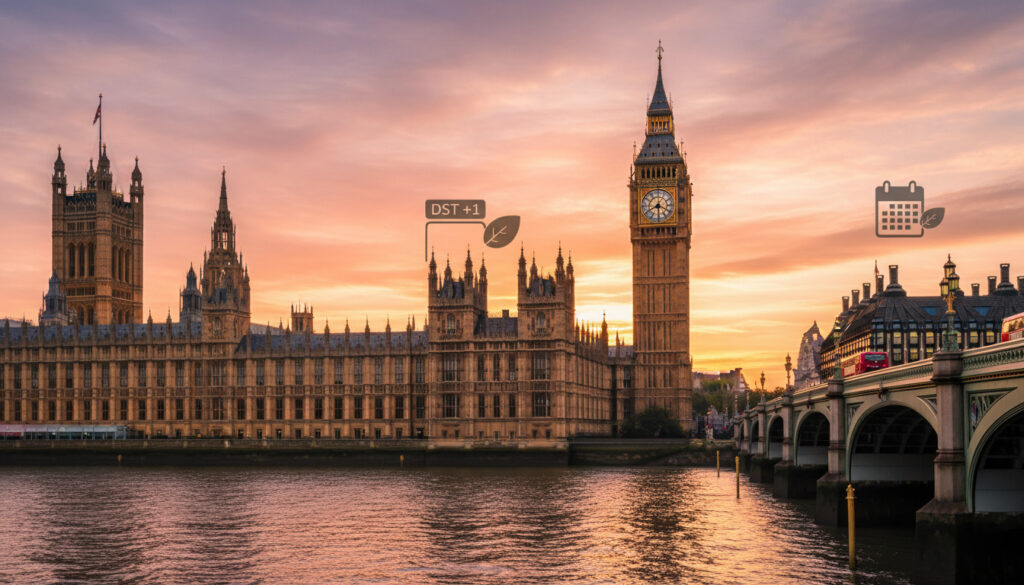
What’s the Time in London – Current BST Status and DST Guide
The current time in London is 9:03 PM BST on Sunday, April 5, 2026. The United Kingdom capital currently observes British Summer Time, placing it one hour ahead of Coordinated Universal Time.
London serves as the global reference point for timekeeping standards. The city sits at the center of the Greenwich Mean Time zone, the foundation from which all world time zones calculate their offsets. This positioning makes accurate London time essential for international business, aviation, and financial markets.
What Is the Current Time in London Right Now?
London currently operates under British Summer Time. The local time reflects the seasonal clock adjustment that occurred on March 29, 2026, when residents moved clocks forward by one hour to extend evening daylight. Time verification services confirm this current offset.
- London currently operates under British Summer Time (BST), which is UTC+1.
- The city follows the Europe/London timezone designation in digital systems.
- Daylight Saving Time began on March 29, 2026, and continues until October 25, 2026.
- During winter months, London reverts to Greenwich Mean Time (GMT) at UTC+0.
- Time zone conversions require checking the current DST status to ensure accuracy.
- International coordination relies on London time as a primary reference standard.
| Fact | Details |
|---|---|
| Current Local Time | 9:03 PM BST, April 5, 2026 |
| Timezone Identifier | Europe/London |
| Active Time Standard | British Summer Time (BST) |
| Standard Winter Time | Greenwich Mean Time (GMT) |
| UTC Offset (Summer) | UTC+1 |
| UTC Offset (Winter) | UTC+0 |
| 2026 DST Start | March 29, 1:00 AM GMT → 2:00 AM BST |
| 2026 DST End | October 25, 2:00 AM BST → 1:00 AM GMT |
| DST Duration | Approximately 7 months |
| Next Clock Change | October 25, 2026 (backward 1 hour) |
What Time Zone Is London In?
London operates within the Europe/London timezone, a designation that encompasses both Greenwich Mean Time and British Summer Time. This dual system means the city shifts between two distinct UTC offsets depending on the season.
The Dual Timezone Architecture
From late October through late March, London maintains GMT at UTC+0. The transition to BST occurs on the last Sunday of March, advancing clocks by one hour to UTC+1. This shift extends daylight hours into the evening during spring and summer months. UTC time references confirm this offset calculation.
When Does the Switch Occur?
The changeover happens at 1:00 AM GMT on the final Sunday of March, immediately becoming 2:00 AM BST. In autumn, the reversal occurs at 2:00 AM BST on the last Sunday of October, returning to 1:00 AM GMT. These specific times minimize disruption to early morning activities and transportation schedules.
British Summer Time consistently maintains a UTC+1 offset. When coordinating international calls or flights, verify whether your local jurisdiction is also observing daylight saving time, as relative differences may vary by one hour depending on regional DST schedules.
Does London Observe Daylight Saving Time?
Yes. The United Kingdom has observed daylight saving time since 1916. The current system follows EU-harmonized rules adopted in 1996, with transitions occurring on the last Sundays of March and October.
The 2026 Transition Calendar
The 2026 schedule began on March 29, when clocks advanced one hour. The period of British Summer Time will conclude on October 25, 2026, when residents set clocks back to GMT. Timezone databases track these transitions for scheduling software and international coordination systems.
Historical Adjustments
Between 1968 and 1971, the UK experimented with permanent BST, effectively remaining at UTC+1 year-round. The trial ended due to adverse effects on northern regions, where winter mornings remained dark until late hours. The current biannual system resumed following this period. Historical records document this shift policy.
UK Parliament sets DST rules through statutory instruments, currently aligned with former EU Directive 2000/84/EC. While the UK has left the European Union, the DST schedule remains synchronized with European neighbors to maintain commercial and transportation coordination.
Time Differences: London vs Major Cities
London’s position as UTC+1 during DST creates specific offsets with major global financial centers. Understanding these differences proves essential for international business operations and travel planning.
London and New York
During daylight saving periods, London sits five hours ahead of New York. When it is 9:00 PM BST in London, Wall Street operates at 4:00 PM EDT. This gap narrows to four hours when New York reverts to standard time in November while London remains on BST through October. World clock converters provide real-time comparisons.
London and Los Angeles
The Pacific coast maintains an eight-hour deficit during summer months. A 9:00 PM BST London timestamp corresponds to 1:00 PM PDT in California. This substantial difference requires careful scheduling for transatlantic communications and financial market overlaps.
International travelers tracking both time and currency fluctuations may find resources like 61 USD to CAD – 84.86 CAD Rate April 1, 2026 useful for cross-border financial planning.
Not all regions observe daylight saving time simultaneously. The southern hemisphere observes DST during opposite months. Always verify the specific date ranges for both locations when calculating time differences, as the gap may shift by one hour twice yearly.
When Do the Clocks Change in London?
The United Kingdom follows a predictable annual pattern for daylight saving transitions. These changes affect scheduling for aviation, international finance, and telecommunications.
- March 29, 2026: Clocks spring forward from 1:00 AM GMT to 2:00 AM BST, marking the start of daylight saving time. Regional time data confirms this transition.
- October 25, 2026: Clocks fall back from 2:00 AM BST to 1:00 AM GMT, returning to standard time for the winter period.
- Year-round synchronization: Atomic clock standards maintained by NIST and other agencies ensure UTC alignment, with leap seconds occasionally inserted to maintain astronomical accuracy.
What Is Certain About London Time?
While London timekeeping follows established protocols, certain distinctions exist between confirmed data and variable elements.
Established Information
- Current BST status active until October 25, 2026
- UTC+1 offset fixed during summer months
- DST transition dates set by UK legislation
- GMT origin at Royal Observatory Greenwich
Uncertain or Variable Elements
- Microsecond-level precision without direct atomic clock access
- Future policy changes to DST permanence
- Potential EU-UK divergence in DST schedules post-Brexit
- Leap second insertion timing
Why Does London Time Matter Globally?
Greenwich Mean Time originated at the Royal Observatory in Greenwich, establishing London as the prime meridian reference point in 1884. This historical designation means GMT remains synonymous with London’s winter time standard.
Global financial markets reference London time for trading sessions. The London Stock Exchange opens at 8:00 AM GMT/BST, creating overlap periods with Asian and American markets that drive international liquidity. Greenwich time standards continue to regulate these activities.
Aviation and maritime navigation rely on UTC, which directly references GMT. Pilots crossing time zones calculate fuel and rest requirements using London time as their baseline coordinate, ensuring standardized safety protocols across international airspace.
Where Does London Time Data Originate?
Official timekeeping derives from atomic standards maintained by the National Physical Laboratory in the UK, synchronized with international UTC standards. The International Earth Rotation Service manages leap second adjustments to compensate for Earth’s irregular rotation.
The UK Parliament establishes DST transition dates through statutory instruments, maintaining alignment with former EU Directive 2000/84/EC despite Brexit, ensuring continental coordination.
— UK Government Time Standards
Digital devices synchronize via Network Time Protocol servers that trace back to these atomic standards. Timezone databases incorporate these legislative changes to ensure software accuracy.
How Can You Track London Time Accurately?
Verify London time through authorized world clock services or by setting devices to the Europe/London timezone for automatic DST adjustments. For financial or legal precision, consult NIST-synchronized sources or official UK government time portals. Travelers managing multiple time zones alongside currency exchanges can reference 103 USD to CAD – Current Rate, Trends and Insights for comprehensive international planning.
Common Questions About London Time
How do I check the time in London?
Use world clock websites synchronized to atomic time standards, or set your device timezone to Europe/London for automatic updates. NIST and official UK time services provide the most accurate references.
What is the time difference between London and New York?
London is currently five hours ahead of New York during daylight saving time. This difference reduces to four hours when the US ends DST in November, before the UK reverts to GMT in late October.
Why does London use two different time zones?
London uses GMT (UTC+0) in winter and BST (UTC+1) in summer to maximize daylight during waking hours. This daylight saving practice reduces artificial lighting needs and aligns working hours with natural sunlight.
Is London time the same as Greenwich Mean Time?
London matches GMT only during winter months. From late March to late October, the city observes British Summer Time (BST), which is one hour ahead of GMT. GMT serves as the winter standard and global time reference.
When will London switch back to GMT in 2026?
London will return to GMT on Sunday, October 25, 2026, at 2:00 AM BST, when clocks move back one hour to 1:00 AM GMT. This marks the end of the daylight saving period.
What countries share London’s time zone?
Ireland, Portugal, and Iceland share GMT (UTC+0) during winter. During BST (UTC+1), London aligns with much of Western Europe including France, Germany, Spain, and Italy under Central European Summer Time.
How did British Summer Time start?
BST began in 1916 as a wartime measure to conserve coal by extending evening daylight. Builder William Willett campaigned for the change, though Germany implemented it first in 1916, with the UK following weeks later.
More related posts
 When the Phone Rings: K-Drama Plot, Ending Explained
 The Fall of the House of Usher: Plot, Cast & Season 2
 Kylie Kelce: Biography, Age, Kids, Podcast and More
 Gary Woodland: Brain Tumor, PTSD, and Golf Comeback
 Charles Barkley Net Worth, Career, and Personal Life
 Jean Coutu St-Eu tache: Two Location , Hour & Service
 Things to Do in Niagara Falls: Top Attractions & Itineraries
 Billie Holiday: Life, Death, Famous Songs & Legacy Explained