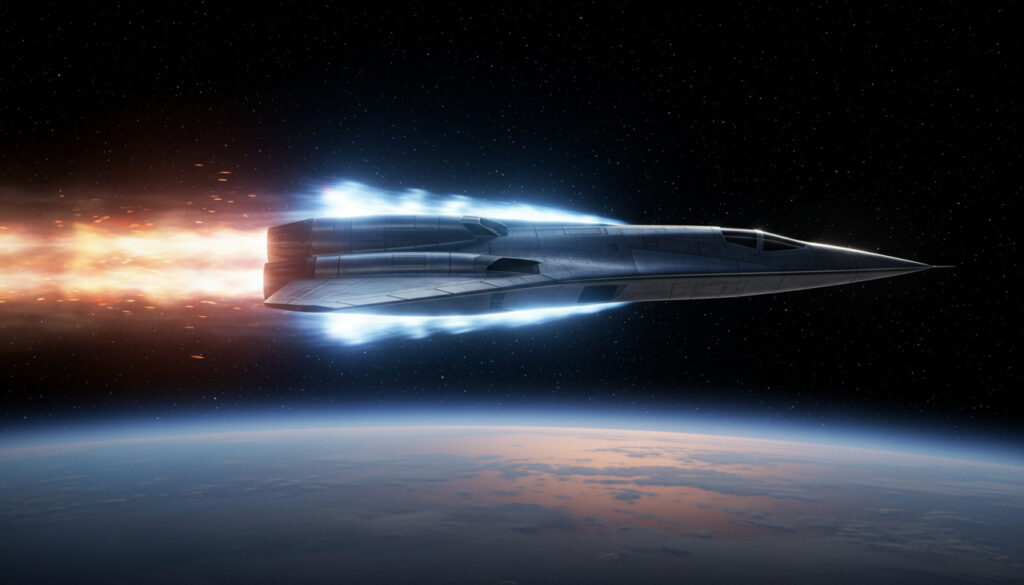
How Fast is Mach 10 – MPH, Km/H Speeds and Altitude Guide
Mach 10 represents a velocity ten times the speed of sound, translating to approximately 7,612 miles per hour at sea level under standard atmospheric conditions. This hypersonic threshold marks the frontier of modern aerospace engineering, where air friction generates temperatures exceeding 2,000°C and ionized plasma disrupts radio communications.
Understanding Mach 10 requires grasping how the Mach number functions as a ratio rather than a fixed speed. Because the speed of sound fluctuates with altitude and temperature, Mach 10 translates to different absolute velocities depending on atmospheric conditions. At 40,000 feet, where colder air slows sound propagation to roughly 660 mph, Mach 10 drops to approximately 6,600 mph compared to 7,612 mph at sea level.
Only uncrewed experimental aircraft have approached this velocity. While military missiles like Russia’s Kinzhal claim Mach 10 capability, sustained crewed flight remains beyond current technology due to extreme thermal loads and physiological limits.
How Fast is Mach 10 in MPH and KM/H?
~7,612 mph / 12,250 km/h
~6,600 mph / 10,600 km/h
10 × 761 mph (Mach 1 at 15°C)
Hypersonic (Mach 5+)
- Mach 10 equals approximately 7,612 mph at sea level under ISA standard conditions, or roughly 6,440 knots.
- At 40,000 feet, Mach 10 decreases significantly because the speed of sound drops to ~660 mph in colder air.
- NASA’s X-43A scramjet holds the uncrewed record at Mach 9.6, just shy of the Mach 10 threshold.
- No crewed aircraft has exceeded Mach 3.3 operationally; hypersonic crewed flight remains theoretical.
- Russia’s Kinzhal missile claims Mach 10 capability, though independent verification remains limited.
- Commercial airliners typically cruise at Mach 0.78-0.85, roughly one-twelfth the speed of Mach 10.
- Conversion between Mach and absolute speeds requires knowing local atmospheric temperature and altitude.
| Speed Unit | Sea Level (15°C) | 40,000 ft (-57°C) | Source Basis |
|---|---|---|---|
| Mach 10 (mph) | ~7,612 | ~6,600 | ISA Model |
| Mach 10 (km/h) | ~12,250 | ~10,600 | Metric Conversion |
| Mach 10 (knots) | ~6,440 | ~5,730 | Nautical Calculation |
| Mach 10 (m/s) | ~3,403 | ~2,950 | Standard Physics |
| Speed of Sound Basis | 761 mph | 660 mph | Atmospheric Data |
| Time to Cross USA | ~20 minutes | ~23 minutes | Calculated Estimate |
What is the Speed of Sound and How Does Mach Work?
The Physics of Sound Propagation
The speed of sound in dry air at sea level reaches 761 mph (1,225 km/h or 661 knots) under International Standard Atmosphere conditions—15°C and mean sea level pressure. This velocity depends entirely on air temperature rather than altitude directly; however, since temperature decreases with height in the troposphere, sound travels slower at cruising altitudes.
Why Does Mach Speed Change with Altitude?
Mach numbers represent ratios of an object’s speed to the local speed of sound. At 40,000 feet, temperatures drop to approximately -57°C, reducing the speed of sound to 660 mph. Consequently, an aircraft traveling at 6,600 mph at this altitude achieves Mach 10, whereas the same absolute speed at sea level would constitute only Mach 8.7.
Aeronautical engineers use the International Standard Atmosphere (ISA) model—15°C at sea level—to ensure consistent Mach calculations. Conversion tools rely on these baseline metrics, though actual flight conditions rarely match ISA standards exactly.
Has Any Aircraft or Vehicle Reached Mach 10?
Uncrewed Hypersonic Demonstrators
NASA’s X-43A scramjet holds the official air-breathing flight record at Mach 9.6 (7,144 mph), achieved during a brief 10-second burn in 2004. The Boeing X-51 Waverider later sustained Mach 5.1 (3,862 mph) for 210 seconds in 2013, demonstrating practical scramjet endurance. Neither vehicle carried passengers or pilots.
Operational Military Systems
Russia’s Kinzhal air-launched ballistic missile claims operational Mach 10 capability, with deployment confirmed during the Ukraine conflict beginning in 2022. Such weapons utilize ballistic trajectories rather than sustained atmospheric flight, distinguishing them from true cruise vehicles. 189 cm in Feet – Exact 6′ 2.41″ Conversion + Guide provides additional context for precise technical measurements.
Crewed Flight Limitations
The Lockheed SR-71 Blackbird established the crewed speed record at Mach 3.3 (2,193 mph) in 1976. Pressure suits and specialized cockpit systems enabled pilots to survive these conditions, but heat accumulation and structural stress prevent conventional aircraft from exceeding Mach 4. Hypersonic crewed flight requires thermal protection systems currently incompatible with human survival needs.
Mach 10 Compared to Everyday Speeds
Ballistic and Projectile Motion
Standard rifle bullets travel at Mach 2 to Mach 3 (1,500-2,300 mph), while high-velocity armor-piercing rounds reach approximately Mach 4. Mach 10 velocities quadruple these projectiles, creating kinetic energy sufficient to destroy hardened structures through impact alone.
Commercial and Military Jets
Commercial airliners cruise at Mach 0.78-0.85 (590-650 mph), while fighter jets typically operate below Mach 2. The SR-71’s Mach 3.3 record stands as the practical limit for crewed atmospheric flight. Mach 10 represents a qualitative leap into hypersonic physics, where atmospheric air becomes a reactive plasma rather than a simple gas.
At Mach 10, air friction generates surface temperatures exceeding 2,000°C—sufficient to melt conventional aluminum airframes. Advanced carbon-carbon composites and active cooling systems become essential for structural integrity.
Velocities above Mach 10 ionize surrounding air into a plasma sheath that absorbs radio signals, causing communication blackouts. Engineers employ laser communications or plasma quenchers to maintain data links during hypersonic flight.
How Has Hypersonic Speed Records Progressed?
- : Chuck Yeager achieves Mach 1.06 (700 mph) in the Bell X-1, breaking the sound barrier.
- : The Lockheed SR-71 Blackbird establishes the crewed speed record at Mach 3.3 (2,193 mph).
- : NASA’s X-43A scramjet reaches Mach 9.6 (7,144 mph) during a brief 10-second burn.
- : The Boeing X-51 Waverider sustains Mach 5.1 (3,862 mph) for 210 seconds, demonstrating scramjet endurance.
- : Russia deploys the Kinzhal air-launched ballistic missile, claiming operational Mach 10 capability during the Ukraine conflict.
What Do We Know for Certain About Mach 10?
| Established Facts | Remaining Uncertainties |
|---|---|
| Mach 10 equals ~7,612 mph at sea level under ISA conditions. | Precise operational speeds of classified hypersonic weapons remain undisclosed. |
| The X-43A holds the verified uncrewed record at Mach 9.6. | Sustained crewed flight above Mach 4 faces unresolved thermal and physiological barriers. |
| Speed of sound decreases with altitude due to temperature drops. | Commercial viability of Mach 10 passenger travel depends on unproven material sciences. |
| Plasma sheath formation begins around Mach 10, disrupting communications. | Exact G-force tolerances for human pilots during hypersonic acceleration require further study. |
Why Does Mach 10 Matter?
Mach 10 capabilities enable prompt global strike weaponry, allowing missiles to reach targets thousands of miles away within minutes. These velocities also promise reduced costs for space access through air-breathing propulsion systems that avoid carrying oxidizers. However, the engineering challenges—managing extreme heat, maintaining stable combustion, and preventing communication blackout—continue to restrict these applications to experimental and military domains. Pots trobar més informació sobre la velocitat del Mach 10 a Resultats de futbol en directe de la BBC.
The pursuit of sustained Mach 10 flight drives advances in materials science, particularly ceramic matrix composites and regenerative cooling technologies. These developments may eventually translate to civilian applications, though significant technical barriers remain before hypersonic transport becomes practical.
Expert Sources and Historical Records
The X-43A research vehicle demonstrated that scramjet propulsion works at Mach numbers approaching 10, providing critical data for future hypersonic cruise vehicles.
— NASA Dryden Flight Research Center, 2004 Flight Summary
What Defines Mach 10 Speed?
Mach 10 represents approximately 7,612 mph at sea level, though this velocity decreases at altitude due to colder atmospheric temperatures. While uncrewed experimental craft like NASA’s X-43A have approached this regime, operational crewed flight remains limited to roughly Mach 3.3. The challenges of extreme heat, plasma communication blackout, and physiological stress continue to constrain hypersonic travel to specialized military applications and experimental research. For additional technical reference standards, consult Normal Blood Pressure by Age – Charts, Ranges and AHA Guidelines.
Frequently Asked Questions
Can humans survive Mach 10 speeds?
Human survival at Mach 10 remains impossible with current technology. Acceleration forces exceeding 9G cause immediate blackout, while friction heats airframes beyond 2,000°C. Pressurization systems fail, and plasma sheaths disrupt life support communications.
What is the fastest manned Mach speed?
The Lockheed SR-71 Blackbird holds the crewed record at Mach 3.3 (2,193 mph), set in 1976. Pilot Brian Shum and Reconnaissance Systems Officer Al Joersz achieved this velocity over the continental United States.
How fast is Mach 10 compared to a bullet?
Mach 10 significantly exceeds standard rifle bullet velocities, which typically travel at Mach 2 to Mach 3 (1,500-2,300 mph). Even high-velocity armor-piercing rounds reach only half the speed of Mach 10 flight.
Why is Mach 10 considered hypersonic?
Aerospace engineers classify speeds above Mach 5 as hypersonic. At Mach 10, airflow chemistry changes fundamentally: molecules dissociate and ionize, creating plasma. This requires specialized scramjet propulsion rather than conventional turbofan engines.
Does Mach 10 speed vary by location?
Yes. Mach 10 represents ten times the local speed of sound, which varies with temperature and altitude. At sea level (15°C), Mach 10 equals 7,612 mph, but at 40,000 feet (-57°C), it drops to approximately 6,600 mph.
What vehicles currently operate at Mach 10?
Only experimental uncrewed aircraft and certain ballistic missiles claim Mach 10 capability. Russia’s Kinzhal missile reportedly reaches these speeds, while NASA’s X-43A achieved Mach 9.6 in 2004. No operational crewed aircraft approaches this velocity.
More related posts
 They Both Die at the End: Plot, LGBT Themes & Bans Explained
 Eva Longoria Movies and TV Shows – Complete Filmography and Best Roles
 Kit Harington Movies and TV Shows: Career & Life Guide
 Browns Social House Cambridge: Menu, Reservations, Reviews
 Tell Me a Joke – Clean Dad Jokes and Funny One-Liners
 Whole Chicken in Air Fryer: Time, Temp & Easy Recipe
 Real Madrid vs Villarreal: Squad, Venue, History & More
 Little Grouse on the Prairie – Identification, Habitat & Conservation