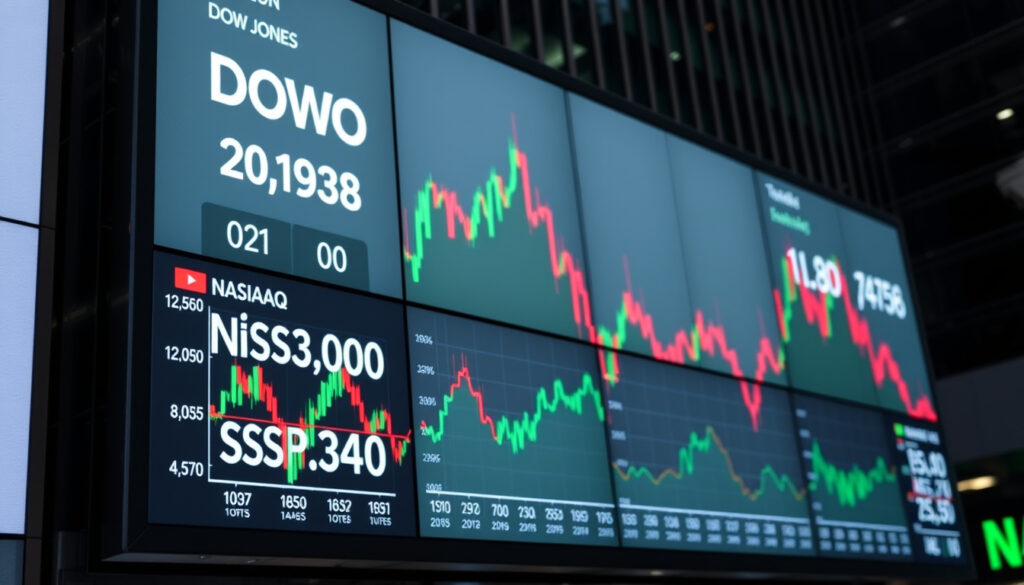
Stock Market Today Live Chart – Real-Time Dow Nasdaq S&P Updates
Tracking the stock market today through live charts gives investors real-time insight into how major indices are performing. This guide covers current index levels, how to interpret live charts, and where to find the most reliable free tools for monitoring US markets.
US stock markets operate Monday through Friday, from 9:30 AM to 4:00 PM Eastern Time. The data below reflects the last completed trading session. Markets are currently closed and will resume on Monday, April 13, 2026.
Where Can I Find Live Stock Market Charts Today?
Several free platforms offer real-time or near-real-time charting tools for major US indices. Each provides slightly different features, so the best choice depends on what you need to track.
- Moneycontrol — Real-time quotes, intraday graphs spanning multiple time frames, sector performance breakdowns, top gainers and losers, plus customizable alerts. moneycontrol.com/us-markets
- Trading Economics — Index quotes paired with interactive charts, weekly market recaps, and global context for broader perspective. tradingeconomics.com
- Nasdaq.com — Intraday charts updated every minute with last-sale data and volume, covering time frames from one minute to one year. nasdaq.com/market-activity
- Business Insider Markets — Live Dow component prices, market news, and analysis covering themes like tech valuations and Federal Reserve policy. markets.businessinsider.com
- Fox Business — Quick market snapshots and news headlines for fast-moving stories. foxbusiness.com/stocks
All five platforms update during active trading hours. On weekdays between 9:30 AM and 4:00 PM ET, prices refresh continuously. After hours and on weekends, charts display the most recent closing values. nyse.com
US exchanges (NYSE and Nasdaq) are closed on weekends and do not open again until Monday, April 13, 2026. The data in this article reflects Friday, April 11, 2026, closing levels.
What Is the Stock Market Doing Today?
Friday, April 11, 2026, produced a mixed close across the three major US indices. While the Dow Jones and S&P 500 dipped slightly, the Nasdaq managed a modest gain. The overall picture for the week was considerably stronger than Friday’s session suggests.
Weekly Performance Overview
Despite Friday’s pullback, all three major indices posted their best weekly gains since November. The S&P 500 climbed over 3%, the Nasdaq surged more than 4%, and the Dow added roughly 3%. That combined performance reflects a week of broadly higher risk appetite across US markets.
Friday’s Trading Session in Numbers
The advance-decline line showed 724 stocks moving higher against decliners on Friday. That balance between gainers and losers illustrates the selective nature of the session — not a broad rally, but not a broad sell-off either.
Amazon, Meta, and Nvidia led the upside on strong momentum in speculative technology, supported by better-than-expected results from TSMC. Verizon, Salesforce, Nike, and IBM weighed on the Dow, while Goldman Sachs offered modest support from the financial sector.
Major Stock Indices Performance Live Today
The table below summarizes closing prices and percentage changes for the three primary US indices based on Friday’s session data.
| Index | Close Price | Change | % Change |
|---|---|---|---|
| Dow Jones | 47,916.57 | -269.23 | -0.56% |
| Nasdaq | 22,902.89 | +80.48 | +0.35% |
| S&P 500 | 6,816.89 | -7.77 | -0.11% |
Sources: Moneycontrol, Trading Economics. Note that minor discrepancies may appear across platforms; figures above reflect the most consistent data sets available from major financial terminals.
Top Individual Stock Performers Friday
Within the Dow and Nasdaq components, notable movers included:
- Nvidia (NVDA): $188.73, up 2.62% (+$4.82)
- Amazon (AMZN): $238.38, up 2.02% (+$4.73)
- Caterpillar (CAT): $790.47, up 0.43% (+$3.40)
- Goldman Sachs (GS): $906.51, up 0.31%
On the losing side:
- Verizon (VZ): $46.05, down 3.62% (-$1.73)
- Salesforce (CRM): $164.99, down 3.43% (-$5.86)
- Nike (NKE): $42.62, down 3.14% (-$1.38)
- IBM: $230.73, down 2.72% (-$6.45)
The technology sector — particularly mega-cap names driving the Nasdaq — provided the most consistent upside. Financial stocks faced headwinds ahead of a week heavy with earnings releases, including reports from major banks.
Some platforms reported slightly different closing figures for the Dow (for example, Fox Business showed 47,909.92). This reflects differences in data feed timing. The figures in this article draw from Moneycontrol and Trading Economics, which maintain high consistency across reporting periods.
How to Read Live Stock Market Charts
Live charts display price movement over time, but understanding what you are looking at requires familiarity with a few key elements.
Understanding Candlestick and Line Charts
Most live charting tools use candlestick format by default. Each candle represents a specific time period — an intraday chart might use one-minute candles, while a weekly chart uses daily candles. Green candles indicate the price rose during that period; red candles indicate a decline.
Key Elements on a Live Chart
- Price line or bars — Show the current price relative to the session open, high, low, and close.
- Volume bars — Displayed below the price chart, high trading volume confirms the strength of a price move.
- Percentage change — Measures movement relative to the previous closing price, expressed as a positive or negative figure.
- Time frames — Options typically range from one-minute (1D intraday) to one-year (1Y), allowing you to zoom in on short-term swings or assess longer trends.
Reading Technical Indicators
Many charting platforms overlay technical indicators such as moving averages and the Relative Strength Index (RSI). Moving averages smooth out price data to reveal directional trends, while RSI measures whether an asset is overbought or oversold on a scale of 0 to 100. Hovering over or zooming into a chart updates real-time ticks every minute during active trading.
Where to Access Charts Outside Trading Hours
Between Friday’s close and Monday’s open, charts on Nasdaq.com and other platforms will display the most recent closing prices. No live trading occurs during weekends or market holidays.
When reviewing a live chart, compare the volume bars beneath the price line to the price movement. A rally on low volume may indicate weaker conviction than one backed by heavy trading activity.
What Drove Market Movement This Week
Several factors contributed to the week’s strong overall performance, even as Friday brought selective selling.
Technology stocks rallied sharply following a ceasefire development that reduced geopolitical risk premiums. Strong quarterly results from TSMC, a key semiconductor supplier, reinforced confidence in the chip supply chain and benefited Nvidia and related names. The prospect of improved global trade conditions lifted sentiment broadly.
Federal Reserve policy remains a counterbalancing force. Analysts including Ruchir Sharma have noted that the central bank is unlikely to rush into aggressive economic stimulus given ongoing oil market shocks. That measured stance keeps rate-sensitive sectors, particularly financials, in a cautious posture ahead of earnings season.
Financial stocks retreated on Friday in part because major banks are due to report earnings in the coming week. JPMorgan is among the most closely watched names. If earnings disappoint, the Dow could face renewed pressure at the start of next week.
Analyst Perspectives Worth Tracking
JPMorgan’s former quantitative analyst raised concerns about a potential tech sector correction following the recent rally. While that view represents one perspective among many, it underscores that elevated valuations in technology names have drawn scrutiny from experienced market participants.
Upcoming Market Events
The week ahead brings several events that could shift market direction:
- Monday, April 13 — US markets reopen. Regular trading hours resume at 9:30 AM ET.
- Financial sector earnings — JPMorgan and other major banks report, offering insight into lending conditions and credit quality.
- Economic data releases — Inflation and employment figures are scheduled; monitor Moneycontrol and Trading Economics for calendars.
- Federal Reserve communications — Any statements on monetary policy could move rate-sensitive sectors.
- Oil market developments — Continued volatility in energy prices may influence consumer discretionary and transportation stocks.
What We Know — and What Remains Uncertain
| Established Information | Uncertain or Pending |
|---|---|
| Dow closed at 47,916.57 on April 11 | Monday opening direction — markets will price in weekend developments |
| Nasdaq closed at 22,902.89 on April 11 | Whether tech rally sustains or faces correction pressure |
| S&P 500 closed at 6,816.89 on April 11 | JPMorgan earnings outcome and financial sector guidance |
| All three indices posted best weekly gains since November | Federal Reserve next policy action and timing |
| Tech stocks (Nvidia, Amazon, Meta) drove Friday upside | Oil shock impact on broader economy and inflation trajectory |
| Financials dipped ahead of earnings season | Exact timing and content of upcoming economic data releases |
Why Real-Time Chart Data Matters
Live charts serve as the most immediate window into how markets are digesting new information. Whether you are tracking the Dow, Nasdaq, or S&P 500, watching price movement in real time during trading hours helps identify shifts in momentum before they become obvious in end-of-day summaries.
For longer-term analysis, the weekly and monthly trends matter more than any single intraday swing. Friday’s -0.56% decline in the Dow looks minor when viewed alongside a week that produced roughly 3% gains overall. Keeping charts in context — across multiple time frames — prevents overreaction to short-term noise.
Investors who follow both live intraday charts and longer-range views are better positioned to distinguish genuine trend changes from routine volatility. Combined with attention to volume, earnings calendars, and macroeconomic indicators, live charting becomes one layer of a broader decision-making framework.
Currency movements can also influence equity performance. The USD to CAD exchange rates page provides current context for US-Canada currency dynamics, while USD/CAD trends and insights offers deeper analysis on how exchange rate shifts interact with cross-border investment flows.
Reliable Sources for Live Market Data
All data referenced in this article draws from official exchange feeds and established financial data providers. The primary sources include Moneycontrol for real-time US market snapshots, Nasdaq for intraday chart updates with minute-by-minute refresh, and Trading Economics for index performance across global markets.
Business Insider Markets provides daily analysis combining price data with expert commentary on themes such as Federal Reserve policy and sector-specific valuations. The Federal Reserve’s official website remains the authoritative source for any central bank announcements.
“Speculative tech rallied post-ceasefire; JPMorgan ex-quant predicts tech crash after rally.” — Business Insider Markets, April 2026
“Fed unlikely to rush economy boost amid oil shock.” — Ruchir Sharma, cited via Business Insider Markets, April 2026
Summary
The stock market closed mixed on Friday, April 11, 2026, with the Dow slipping 0.56% and the S&P 500 down 0.11%, while the Nasdaq eked out a 0.35% gain. Despite that subdued close, the week as a whole delivered the strongest gains for major indices since November, driven by technology stocks and improved risk appetite. Tech leaders Nvidia, Amazon, and Meta led the advance, while financials and large-cap industrials like Verizon, Salesforce, and Nike retreated. Major bank earnings arriving next week will test whether the financial sector’s recent softness reflects pre-announcement caution or something more structural. Live charts remain the most accessible tool for tracking these shifts as they happen, and free platforms like Moneycontrol, Nasdaq.com, and Trading Economics make real-time data available without a subscription.
Frequently Asked Questions
What time does the stock market open today?
US stock markets open at 9:30 AM Eastern Time and close at 4:00 PM ET, Monday through Friday. They are currently closed for the weekend and will reopen Monday, April 13, 2026.
How do I get alerts for stock market changes?
Platforms like Moneycontrol allow you to set price alerts on specific stocks or indices. Enter your target price, and you will receive a notification when the asset crosses that level during active trading hours.
Are live stock charts free to use?
Yes. Moneycontrol, Trading Economics, Nasdaq.com, Business Insider Markets, and Fox Business all offer free live chart tools with no subscription required.
What is the difference between the Dow, Nasdaq, and S&P 500?
The Dow Jones tracks 30 large US companies, the Nasdaq reflects technology-focused and non-financial companies listed on the Nasdaq exchange, and the S&P 500 covers 500 large US companies across all sectors, weighted by market capitalization.
Why did the Nasdaq gain while the Dow fell on Friday?
Technology stocks within the Nasdaq — including Nvidia, Amazon, and Meta — posted strong gains on positive sentiment around TSMC results and post-ceasefire risk appetite. The Dow’s decline was driven by weakness in Verizon, Salesforce, Nike, and IBM, which outweighed modest gains in Goldman Sachs and Caterpillar.
Can I trade outside regular market hours?
Extended-hours trading (pre-market and after-hours) is available through most brokers, but liquidity is lower and price execution may be less reliable than during standard trading hours.
What does volume show on a stock chart?
Volume represents the number of shares traded during a given period. High volume accompanying a price move signals stronger conviction behind that move; low volume may suggest the move lacks broad market support.
More related posts
 We Wish You a Merry Christmas Lyrics – Full Text, History and Chords
 Luke Roberts: Holby City, Game of Thrones & Hudson and Rex
 Coffee Table with Storage: IKEA, Round & Ireland Options
 Xbox Game Pass PC: Pricing, Games & Deals Guide
 Flight Cancellations Tourism Impact: Fuel Crisis Hits UK
 Kick-Ass (Film) – Plot, Cast, Reviews, Sequels
 Dental Braces vs Invisalign – Cost, Time, Comfort Compared
 LSG vs PBKS Timeline: Full Head-to-Head Record